Define a bounded subject
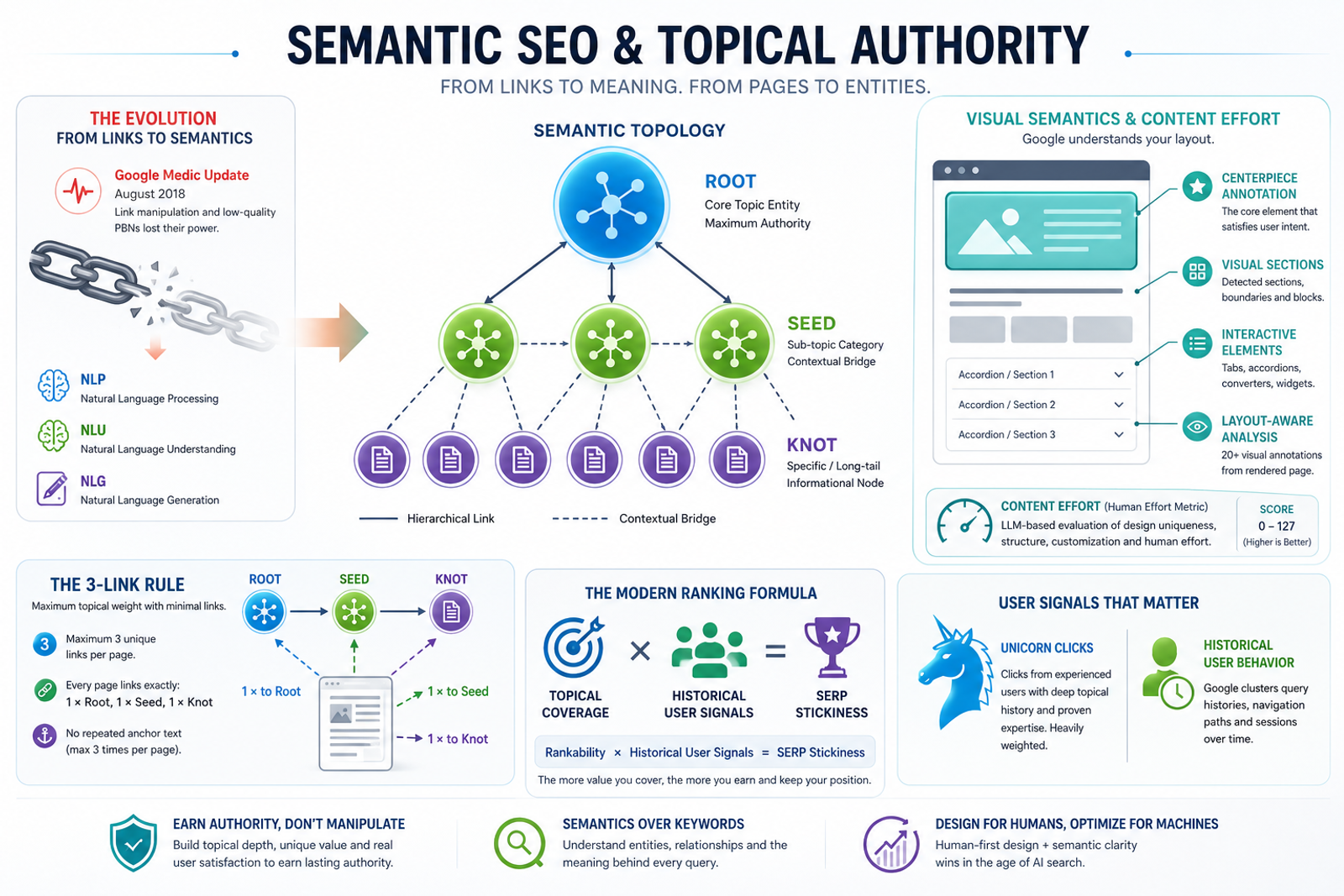
Choose the audience and decision the site serves. Topical coverage is useful when it helps visitors understand that subject and evaluate the provider. There is no public trust-score formula in the sources below that turns page counts, a three-link rule, or named practitioner concepts into guaranteed rankings.
Inventory existing pages
Record each URL, audience, main task, content owner, evidence, next step, and revision date. Start with what exists rather than generating new pages from keyword variations. One page may answer several closely connected questions.
Review an illustrative service cluster
| Page | Distinct purpose | Evidence to supply |
|---|---|---|
| Service | Explain the offer and boundaries | Sample deliverable |
| Implementation guide | Teach a specific method | Worked example and sources |
| Case study | Show what changed | Dates, baselines, and role |
| Biography | Identify the author | Real experience and credentials |
Improve weak relationships
A service explanation can link to an implementation guide; a case study can link back to the actual service used. Link by meaning and usefulness. Do not insert a fixed number of links or repeat the same anchor everywhere merely to meet a formula.
Distinguish frameworks from search documentation
Practitioner frameworks can be useful planning tools. Patents, leaked field names, and commentary do not by themselves establish how a live ranking system uses a signal today. Label inference clearly and provide the original material when discussing it.
Check the publishing layer
Confirm the actual rendered headings, links, dates, canonicals, and article/author records. A good plan can be weakened by a renderer that turns paragraphs into headings or a CMS that drops relationship fields.
Measure a defined change
Keep country, device, pages, and query groups comparable. Record implementation dates and business outcomes. Low-volume observations need time and careful interpretation; do not declare success from one citation or impression.